
Why Do Some Coworkers Question Everything? Understanding Skepticism at Work
Oct 21, 2026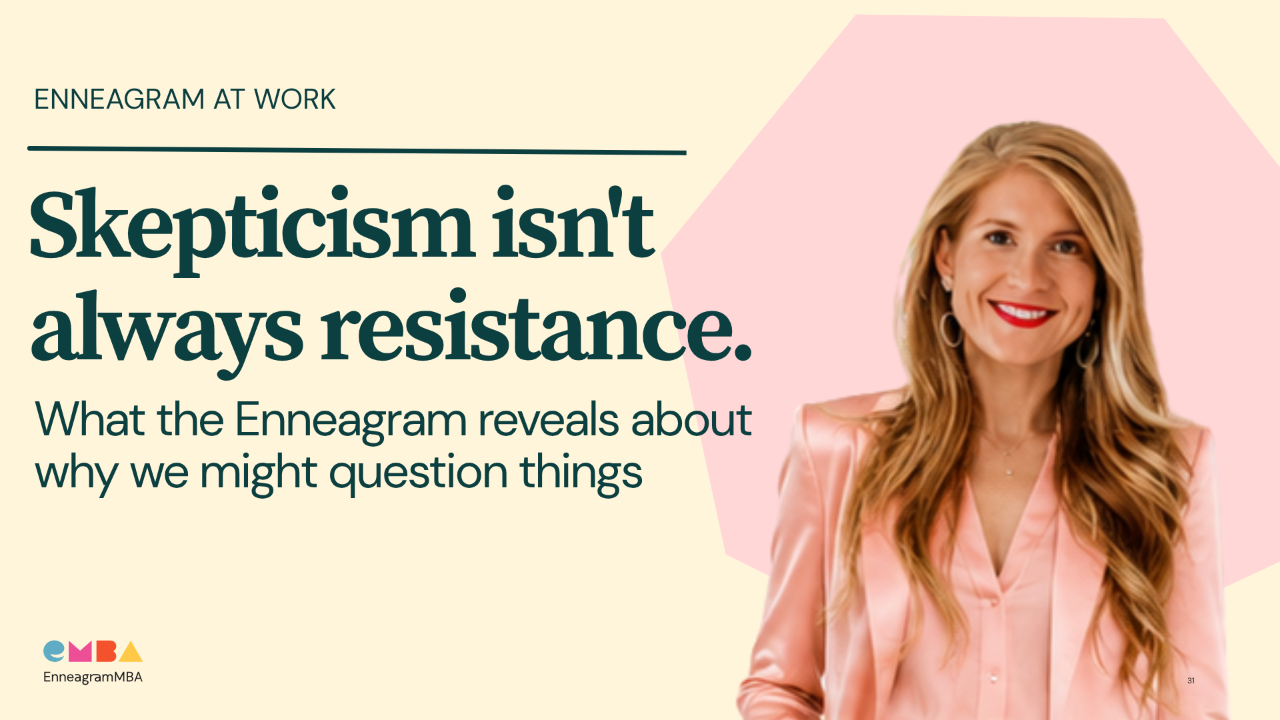
We've all worked with someone who seems to question everything.
You introduce a new process, and they immediately identify what could go wrong. You present an idea, and they want more information. You suggest a change, and they start pointing out everything that could be improved.
Depending on the situation, those questions can feel like criticism, negativity, or even resistance.
But what if the person asking all those questions isn't trying to be difficult? What if they're noticing something important that the rest of the team is overlooking?
That's where understanding the motivation behind someone's skepticism can change the conversation.
Using the Enneagram as a framework, let's explore three different reasons coworkers might question the same idea, and how leaders can respond in ways that build understanding instead of frustration.
Skepticism at Work Isn't Always Resistance
Imagine you're presenting a new onboarding process to your team.
Three people start asking questions.
One notices inconsistencies between the proposed process and existing company policies. Another wants to understand the technology and research behind the change. A third asks what happens if implementation falls behind schedule.
From the outside, all three might look skeptical.
But their questions could be coming from three very different places.
The Enneagram offers one way to explore those differences by looking beyond what someone is doing to consider what might be motivating their behavior.
Rather than immediately labeling a coworker as negative or difficult, we can get curious about what they're trying to accomplish—or protect.
Here are three examples through the lens of Enneagram Types 1, 5, and 6.
1. Type 1: Questioning to Improve
“Is this the right way to do it?”
In the Awareness to Action approach to the Enneagram, Type 1 uses a strategy of striving to feel perfect.
This often means paying close attention to standards, integrity, and opportunities for improvement.
When a Type 1 questions an idea, they may be noticing inconsistencies, errors, or areas where something could be done better.
For example, imagine a leader introducing that new onboarding process.
A Type 1 coworker immediately notices three inconsistencies between the proposed procedures and existing company policies.
What the leader might hear: "You're finding fault with everything."
What the coworker might actually be thinking: "I want us to do this well, and I can see where we're falling short."
Those are two very different interpretations of the same behavior.
Of course, constant suggestions for improvement can sometimes feel like criticism, especially when someone has worked hard on an idea.
But what if we approached those questions as potential contributions rather than challenges to our competence?
How to respond: Ask, "What standard or principle do you feel we're missing here?"
Make room for suggestions. There may be an important improvement worth considering.
2. Type 5: Questioning to Understand
“Do we have enough information?”
Type 5, in the Awareness to Action framework, uses a strategy of striving to feel detached.
Fives often value knowledge, competence, and having the information necessary to make an informed decision.
Their questions may not reflect disagreement at all.
They may simply be trying to understand what's being proposed before deciding whether they agree.
Return to our onboarding example.
A Type 5 coworker wants to know how the new technology works, how it will integrate with existing systems, and what data supports the recommendation.
What the leader might hear: "You're overcomplicating this."
What the coworker might actually be thinking: "I want to understand what we're getting into before we commit."
For someone who prefers to make decisions quickly and figure things out along the way, this approach can feel unnecessarily slow.
But asking thoughtful questions before moving forward can prevent confusion and expensive mistakes later.
How to respond: Share information and context in advance whenever possible. Answer questions directly and allow time to process before requiring a decision.
Sometimes the most helpful thing you can say is, "Here's what we're considering. Take some time to review it, and we'll discuss it together next week."
3. Type 6: Questioning to Establish Trust
“Have we thought through what could go wrong?”
Type 6 uses a strategy of striving to feel secure.
Sixes may pay particular attention to potential risks, uncertainty, trustworthiness, and whether there are adequate plans in place if something doesn't go as expected.
Their skepticism can be especially valuable when a team is moving quickly toward a decision.
With our new onboarding process, a Type 6 coworker might ask:
-
What happens if implementation falls behind schedule?
-
Who's responsible if something goes wrong?
-
Do we have enough resources and support?
-
What's our backup plan?
What the leader might hear: "You're being so negative."
What the coworker might actually be thinking: "I want to know we're prepared before we move forward."
This is a particularly important distinction.
When leaders experience questions as challenges to their authority, they may become defensive or dismissive.
But the person raising concerns may care deeply about the team's success.
They're simply looking at the decision through a different lens.
How to respond: Treat risk assessment as a valuable contribution rather than resistance. Be transparent about responsibilities, decision-making, and contingency plans.
You don't have to eliminate every uncertainty. But helping someone understand how risks will be managed can build trust.
Three People. Three Reasons to Question the Same Idea.
Notice what happens when we look beyond the behavior.
| Enneagram Type | Possible Motivation | What They May Need |
|---|---|---|
| Type 1 | Getting it right and improving the outcome | Confidence that important standards are being met |
| Type 5 | Understanding before committing | Information, context, and processing time |
| Type 6 | Establishing trust and preparing for uncertainty | Clarity around risks, responsibilities, and contingency plans |
These aren't fixed rules about how people behave.
Any Enneagram type can care about quality, information, and security.
But the examples remind us that the same behavior can be motivated by very different concerns.
And understanding those differences can help us respond more effectively.
Skepticism Isn't Just About Your Enneagram Type
There's another important layer to this conversation.
Your Enneagram type isn't the only thing influencing what you're likely to question.
In the Awareness to Action approach, we also explore three Instinctual Biases: Preserving, Navigating, and Transmitting.
These help explain what naturally captures our attention and which concerns we're more likely to prioritize.
For example:
-
Preserving: Attention tends toward resources, time, energy, well-being, and sustainability.
-
Navigating: Attention tends toward relationships, roles, responsibilities, trust, and social dynamics.
-
Transmitting: Attention tends toward expression, influence, impact, and reaching others.
These biases can influence what someone notices first when a new idea or decision is introduced.
How a Preserving Instinctual Bias Can Influence Skepticism
Someone with a strong Preserving bias may be particularly attentive to whether the team has the resources, capacity, and energy to follow through on a proposal.
And this isn't limited to Types 1, 5, or 6.
Consider a Type 7, often associated with enthusiasm, possibilities, and new experiences.
A Seven might love an exciting new idea and be eager to explore what's possible.
But a Seven with a strong Preserving bias might also ask:
"This sounds amazing! But do we actually have the budget and bandwidth to make it happen?"
The enthusiasm and skepticism can exist together.
That person doesn't suddenly become a Type 6 because they're questioning the plan.
Their Instinctual Bias may simply be directing more of their attention toward resources and sustainability.
Likewise, someone with a Navigating bias might question how the decision will affect relationships or responsibilities, while someone with a Transmitting bias might question whether the idea will have the intended impact.
This is one reason I appreciate the Awareness to Action approach.
Your Enneagram type can offer clues about why you question something. Your Instinctual Bias can offer clues about what you're paying attention to when you do.
Neither determines your behavior. But together, they give us more possibilities to explore before making assumptions.
How to Respond When a Coworker Questions Your Decisions
Whether you're leading a team, collaborating with peers, or introducing a change, you don't have to know anyone's Enneagram type to respond more effectively to skepticism.
Sometimes all it takes is a better question.
Here are three to try:
1. "What about this doesn't feel right yet?"
This gives someone room to explain a concern without feeling like they need to defend their skepticism.
2. "What additional information would be helpful?"
This recognizes that someone may need more context before they're ready to support a decision.
3. "What concerns do you have that we haven't addressed?"
This invites someone to share potential risks or blind spots that may ultimately strengthen the plan.
And here's the important part: You don't have to agree with every concern.
You don't even have to change your decision.
But taking the time to understand someone's perspective communicates respect, and that can go a long way toward strengthening trust.
You Don't Need to Know Someone's Enneagram Type to Get Curious
One of the biggest challenges in workplace communication is how quickly we assign meaning to someone else's behavior.
Their questions become resistance.
Their suggestions become criticism.
Their concerns become negativity.
And once we've decided what someone's behavior means, it's easy to stop listening.
The Enneagram gives us a framework for considering other possibilities, but ultimately, the goal isn't to become better at guessing people's personality types. It's to become better at understanding people.
And sometimes that means recognizing that we may have misunderstood someone's intentions.
It also means accepting that we won't always get it right in the moment. Even with greater self-awareness, we can still become defensive, frustrated, or emotional.
When that happens, we can return to the conversation, ask better questions, and work toward repairing the misunderstanding.
The Takeaway: Skepticism Can Be a Contribution
The next time a coworker questions an idea, challenges a decision, or pushes back on a new process, consider a different possibility.
Maybe they're not resisting change.
Maybe they're trying to improve the outcome, understand the reasoning, establish trust, or protect resources that the rest of the team hasn't considered.
Skepticism isn't always resistance. Sometimes it's someone noticing something important that everyone else has overlooked.
And we don't have to agree with someone's perspective to become curious about it.
The next time someone questions your idea, try asking one question to understand what's underneath their concern before jumping in to defend your position.
You might discover that the person you thought was being difficult is actually helping your team make a better decision.
Listen: Why We Question Things - What the Enneagram Reveals About Skepticism at Work
This article was inspired by an episode of the Enneagram at Work podcast, where I explore why Types 1, 5, and 6 might question the same idea for different reasons, using practical workplace examples.
The conversation was also inspired by a recent exchange between Adam Grant and Brené Brown about the Enneagram.
For more on that conversation, read Adam Grant and the Enneagram: Is His Skepticism Justified?.
Bring Better Conversations to Your Team
At Enneagram MBA, we help organizations turn personality insights into practical conversations about communication, collaboration, and workplace relationships.
Through facilitated team workshops, leadership retreats, and development programs, teams learn to recognize their own patterns, better understand their coworkers, and develop a shared language for working through differences.
Explore our Team Communication Training or browse our Enneagram Workshop Planning Kit to start planning an experience for your team.
Written by Sarah Wallace, Founder and Managing Director of Enneagram MBA and host of the Enneagram at Work podcast.
Looking for an Enneagram facilitator for your team?
If you're considering bringing the Enneagram into your workplace, start by telling us a little about what's going on with your team. We'll help you think through what kind of experience might make the most sense, whether that's a standalone workshop, continued team development, or something across multiple teams or departments.